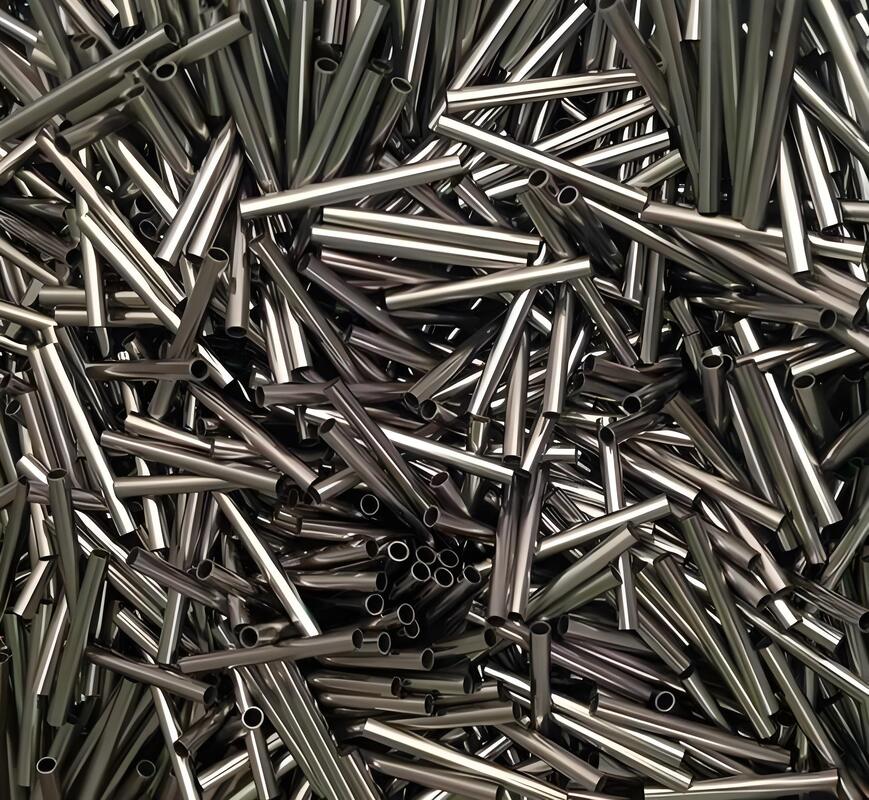
Détails de produit
Lieu d'origine: Shanghai, Chine
Nom de marque: TANKII
Certification: ISO9001, SGS
Numéro de modèle: invar36
Conditions de paiement et d'expédition
Quantité de commande min: 10 kg
Prix: Négociable
Détails d'emballage: caisse en bois
Délai de livraison: 7-20 jours
Conditions de paiement: LC, T/T, Western Union
Capacité d'approvisionnement: 100 tonnes par mois
Numéro de modèle.: |
Invar 36 |
DO: |
0,20 mm minimum |
POIDS: |
0.015 mm |
Longueur: |
0,20 mm minimum. |
Forme: |
tuyau en serpentin ; Tuyau capillaire Tuyaux sans soudure |
Surface: |
Surface brillante |
Échantillon: |
petite commande acceptée |
Numéro de modèle.: |
Invar 36 |
DO: |
0,20 mm minimum |
POIDS: |
0.015 mm |
Longueur: |
0,20 mm minimum. |
Forme: |
tuyau en serpentin ; Tuyau capillaire Tuyaux sans soudure |
Surface: |
Surface brillante |
Échantillon: |
petite commande acceptée |
4J36 (Invar) is used where high dimensional stability is required, such as precision instruments, clocks, seismic creep gauges, television shadow-mask frames, valves in motors, and antimagnetic watches. In land surveying, when first-order (high-precision) elevation leveling is to be performed, the Level staff (leveling rod) used is made of Invar, instead of wood, fiberglass, or other metals. Invar struts were used in some pistons to limit their thermal expansion inside their cylinders.
4J36 use oxyacetylene welding, electric arc welding, welding and other welding methods. Since the coefficient of expansion and chemical composition of the alloy is related should be avoided due to welding causes a change in the alloy composition, it is preferable to use Argon arc welding welding filler metals preferably contains 0.5% to 1.5% titanium, in order to reduce weld porosity and crack.
Normal composition%
| Ni | 35~37.0 | Fe | Bal. | Co | - | Si | ≤0.3 |
| Mo | - | Cu | - | Cr | - | Mn | 0.2~0.6 |
| C | ≤0.05 | P | ≤0.02 | S | ≤0.02 |
Coefficient of expansion
| θ/ºC | α1/10-6ºC-1 | θ/ºC | α1/10-6ºC-1 |
| 20~-60 | 1.8 | 20~250 | 3.6 |
| 20~-40 | 1.8 | 20~300 | 5.2 |
| 20~-20 | 1.6 | 20~350 | 6.5 |
| 20~-0 | 1.6 | 20~400 | 7.8 |
| 20~50 | 1.1 | 20~450 | 8.9 |
| 20~100 | 1.4 | 20~500 | 9.7 |
| 20~150 | 1.9 | 20~550 | 10.4 |
| 20~200 | 2.5 | 20~600 | 11.0 |
| The heat treatment process | |
| Annealing for stress relief | Heated to 530~550ºC and hold 1~2 h. Cold down |
| annealing | In order to eliminate hardening, which be bring out in cold-rolled, cold drawing process. Annealing needs heated to 830~880ºC in vacuum,hold 30 min. |
| The stabilization process |
|
| Precautions |
|
Typical Physical properties
| Density (g/cm3) | 8.1 |
| Electrical resistivity at 20ºC(OMmm2/m) | 0.78 |
| Temperature factor of resistivity(20ºC~200ºC)X10-6/ºC | 3.7~3.9 |
| Thermal conductivity, λ/ W/(m*ºC) | 11 |
| Curie point Tc/ ºC | 230 |
| Elastic Modulus, E/ Gpa | 144 |
![]()